OmmatidiaOmmatidiaOmmatidiaOmmatidia
  • Produits
    • LDV à faisceau unique
      • SpeedSync
      • QMini LDV Station
    • RADAR laser parallèles
      • Laser RADAR Q1S
      • Q1 · Balayage
      • Q2 · Scanning, 3D
    • Logiciel Q-Series
      • Atelier
      • OmmH5Viewer
      • Logiciel d’analyse OmmH5Viewer
      • Logiciel d’acquisition de données Atelier
  • Services
    • OmmRent
    • OmmService
  • Applications
    • Acoustique, bruit et vibrations
    • Construction & Civil Engineering Measurement
    • Énergie
    • Métrologie industrielle et contrôle de processus
    • Espace
  • Ressources
    • Centre de connaissances
    • Technologie
    • Publications
    • Actualités de la vibrométrie
  • Entreprise
    • Distributeurs agréés
    • Nos clients
    • Investors
  • Français
    • Anglais
    • Espagnol
    • Allemand
    • Italien
    • Japonais
    • Coréen
    • Portugais - du Brésil
    • Néerlandais
    • Chinois simplifié
Français
  • English
  • Español
  • Deutsch
  • Italiano
  • 日本語
  • 한국어
  • Português
  • Nederlands
  • 简体中文
Contactez-nous
✕
Categories
  • Non catégorisé
Tags
  • Capteur radar laser Q1
  • LiDAR
  • Radar laser
  • Technologie Laser Radar
  • Vibrométrie

Measurement, vibrometry & metrology

LiDAR vs RADAR vs Laser RADAR: Choosing the Right Measurement Method

LiDAR, conventional RADAR and Laser RADAR are not interchangeable labels. LiDAR uses light for ranging and spatial mapping. Conventional RADAR uses radio waves for detection, ranging and velocity measurement. Coherent Laser RADAR is also optical: it uses laser light and interferometric methods for precisely referenced geometry and, in suitable configurations, remote vibration measurement.

Choose the method from the engineering output, range, environment, spatial coverage and motion bandwidth your task requires.

Find your Q-Series system

LiDAR vs RADAR vs Laser RADAR: a direct answer

LiDAR uses light to measure distance and build spatial data. Conventional RADAR uses radio waves and is commonly chosen for detection, ranging and velocity sensing over long distances or in difficult weather. Coherent Laser RADAR also uses light, but applies frequency and phase measurement to deliver precisely referenced range information and, where configured, non-contact vibration data.

Despite its name, Laser RADAR is an optical measurement method, not radio-frequency RADAR. None is universally better: the correct choice depends on the required output, range, environment, surface return, spatial coverage, motion bandwidth and validation plan.

Choose a measurement approach

Questions teams ask before choosing LiDAR, RADAR or Laser RADAR

What is the practical difference between LiDAR, RADAR and Laser RADAR?

The first distinction is the signal. LiDAR and Laser RADAR are optical methods that use light; conventional RADAR uses radio-frequency energy. LiDAR is commonly selected for broad spatial mapping and scene capture. Radio RADAR is commonly selected for detection and ranging where long distance, relative velocity or weather tolerance matter. A coherent FMCW Laser RADAR workflow becomes relevant when an engineering team needs precisely referenced geometry and, where configured, remote vibration data alongside range.

The name alone does not choose the instrument. Define the quantity of interest, coverage, stand-off, target surface, environmental conditions, motion bandwidth and required validation before comparing systems.

When should an engineering team choose LiDAR?

LiDAR is a sensible starting point when the main job is broad three-dimensional context, navigation-oriented perception or scalable scene capture. The team should define coverage, update rate, range, target materials and the geometry accuracy needed for the decision. A mapping workflow should also state how its data will be registered, checked and delivered. It is not automatically a vibration or engineering-metrology workflow. If the result must describe dynamic response, traceable geometry or a tightly defined tolerance, those requirements should be written into the measurement plan before equipment is chosen. This prevents a broad point-cloud requirement from being mistaken for evidence of motion, deformation or a validated metrology result. It helps procurement, operations and test teams agree on what the data must demonstrate.

When should an engineering team evaluate Laser RADAR?

Evaluate a Laser RADAR workflow when the decision depends on precision geometry, remote dynamic response or combining shape and motion in one measurement campaign. For parallel vibration capture, Q2 provides 65 simultaneous channels and supports up to 1,300 measurement points with 20u00d7 oversampling; Q1, Q1S and Q2 measure vibration velocity to u00b1155 mm/s. These are configuration and planning inputs, not a universal-fit claim. Optical access, target return, range, motion bandwidth and the required validation still govern the method choice. A feasibility discussion should identify the output, measurement positions, reference method and acceptance criteria before a system configuration is selected, especially where a geometry result and a vibration result must agree. This makes the configuration decision auditable rather than relying on a generic technology comparison.

Technical basis and review

Mapping reference. The USGS Lidar Base Specification shows how collection requirements and quality levels are linked to an intended mapping output. It is a public-sector mapping reference, not a substitute for an industrial metrology or vibration test plan.

Dynamic-measurement reference. Rothberg et al. (2017) reviews laser Doppler vibrometry principles and practical measurement considerations. Use both references as method context, then validate the chosen workflow against the specific target and acceptance criteria.

Technical review. Reviewed by Jose Luis Rubio, Ommatidia, on 8 August 2026.

LiDAR vs RADAR vs Laser RADAR at a glance

Decision areaLiDARConventional RADARCoherent Laser RADAR
SignalLaser lightRadio wavesLaser light
Typical outputPoint clouds and spatial mapsDetection, range and radial velocityPrecisely referenced range and geometry; remote velocity or vibration where configured
Common strengthBroad scene capture and spatial awarenessLong-range sensing and operation in conditions that challenge optical methodsEngineering metrology and optical dynamic measurement from stand-off
Key planning constraintsCoverage, update rate, range, target return and required accuracyFrequency band, resolution, interference, target cross-section and environmentOptical access, surface return, range, motion bandwidth, coverage and validation

Choosing between LiDAR and Laser RADAR for a real measurement task?

Choose your next step based on the data you need: system comparison, remote vibration insight, structural monitoring, or an engineering discussion.

Compare Q-Series systems

Explore by application

Explore remote vibrometry
Explore structural monitoring
Discuss industrial metrology

Measurement principle

What is Laser RADAR?

At the sensing level, Laser RADAR uses frequency-modulated continuous-wave (FMCW) ranging together with phase information in the returned optical signal.

That distinction matters in engineering. In a remote vibrometry workflow, velocity data supports the interpretation of resonances, mode shapes, and structural response. Ommatidia Q2 extends this with parallel capture: 65 simultaneous channels and up to 1,300 measurement points with 20u00d7 oversampling when the task needs more than a single measurement location. Read the Laser Doppler vibrometry overview for the underlying measurement context.

FMCW + phase information

Compare the transmitted and returned optical signals to resolve range and, when the target is moving, velocity.

65 simultaneous channels; up to 1,300 points (20u00d7 oversampling)

Q1 and Q2 extend the approach beyond a single location, helping teams capture richer dynamic information in one workflow.

Choose LiDAR for broad spatial context

Use time-of-flight capture for efficient coverage, point clouds, mapping, and situational awareness across a wide scene.

Choose Laser RADAR when precision matters

Use advanced optical ranging when you need precision geometry, stand-off access, vibration measurement, or both shape and motion.

How the measurement principles differ

Time-of-flight and frequency-based ranging answer different measurement questions.

LiDAR: time-of-flight ranging

A pulse travels to the target and back. That return time provides distance information for scalable spatial capture.

Laser RADAR: frequency-based ranging

Frequency and phase information support precise range measurement and can reveal motion over time.

Find the Q-Series fit for your measurement

Start with the scope of the task. The comparison hub turns measurement range, point density, and dynamic-data needs into a clearer product choice.

QMini

For focused single-point vibrometry and a fast route into non-contact measurement.

Q1S

For teams evaluating a compact Q-Series path around their measurement range and workflow.

Q1

For long-range inspection and precision metrology context.

Q2

For high-density dynamic characterisation and full-field vibrometry work.

Compare all Q-Series

Applications of LiDAR vs Laser RADAR

LiDAR suits broad spatial capture and navigation-oriented workflows. Laser RADAR comes into its own when the engineering decision depends on precision geometry, remote dynamic response, or the ability to connect shape and motion in the same measurement campaign.

Precision metrology

Capture dimensional information for production and inspection decisions.

Remote NVH and modal testing

Record vibration across many points without mounting a sensor at each location.

Structural response

See geometry and dynamic response together for demanding structures.

Questions teams ask before choosing

Quelle est la différence pratique entre LiDAR, RADAR et Laser RADAR ?

LiDAR, RADAR radiofréquence et Laser RADAR cohérent répondent à des objectifs de mesure distincts. Le LiDAR crée de larges cartes 3D et le contexte de la scène. Le RADAR utilise des ondes radio pour mesurer la distance et la vitesse radiale. Le Laser RADAR FMCW cohérent fournit distance et géométrie avec une référence précise et associe forme et vibration sans contact.

Quand le LiDAR constitue-t-il le bon point de départ ?

Choisissez le LiDAR pour un contexte tridimensionnel étendu, la perception dédiée à la navigation et l’acquisition évolutive de scènes. Définissez champ de vision, portée, densité de points, fréquence de mise à jour, matériaux, précision géométrique et format de livraison pour adapter l’instrument à la cartographie.

Quand faut-il choisir le Laser RADAR ?

Choisissez le Laser RADAR cohérent pour la géométrie de précision, la réponse dynamique à distance ou des données combinant forme et mouvement. Q2 acquiert 65 canaux simultanément et prend en charge jusqu’à 1 300 points avec un suréchantillonnage 20× ; Q1, Q1S et Q2 mesurent la vitesse vibratoire jusqu’à ±155 mm/s.

Que doit préciser le cahier des charges avant le choix technologique ?

Précisez la décision d’ingénierie, la grandeur mesurée, la géométrie de la cible, la distance de travail, la couverture spatiale, la précision, la bande passante du mouvement, l’environnement et le format de livraison. Ces éléments permettent de comparer les technologies sur un même objectif et de configurer le bon flux.

Puis-je discuter de la mesure avec un ingénieur avant de choisir un système ?

Oui. Partagez l’objectif de l’application, la géométrie et le matériau, la distance de travail, la précision, le mouvement ou la bande passante attendus, l’environnement d’essai, la couverture spatiale et les données souhaitées. Un ingénieur Ommatidia reliera ces exigences au flux Q-Series le plus utile.

Ready to plan your measurement workflow?

Bring your target, required accuracy, access constraints, and vibration-data needs. Our engineers can help you identify the right Laser RADAR workflow and Q-Series system.

Discuss your measurement
Compare Q-Series
Share

Related posts

5 août 2026
Magnitude and phase maps for six resonance modes of an aluminum hemispherical dome from 20 Hz to 925 Hz
Categories
  • Non catégorisé

Analyse modale par LDV d’un dôme en aluminium

Analyse modale LDV sans contact d’un dôme hémisphérique en aluminium, avec six résonances mesurées de 20 Hz à 925 Hz et une comparaison de fréquence par modèle de coque à ordre réduit.
30 juillet 2026
Categories
  • Non catégorisé
  • Notes d’application

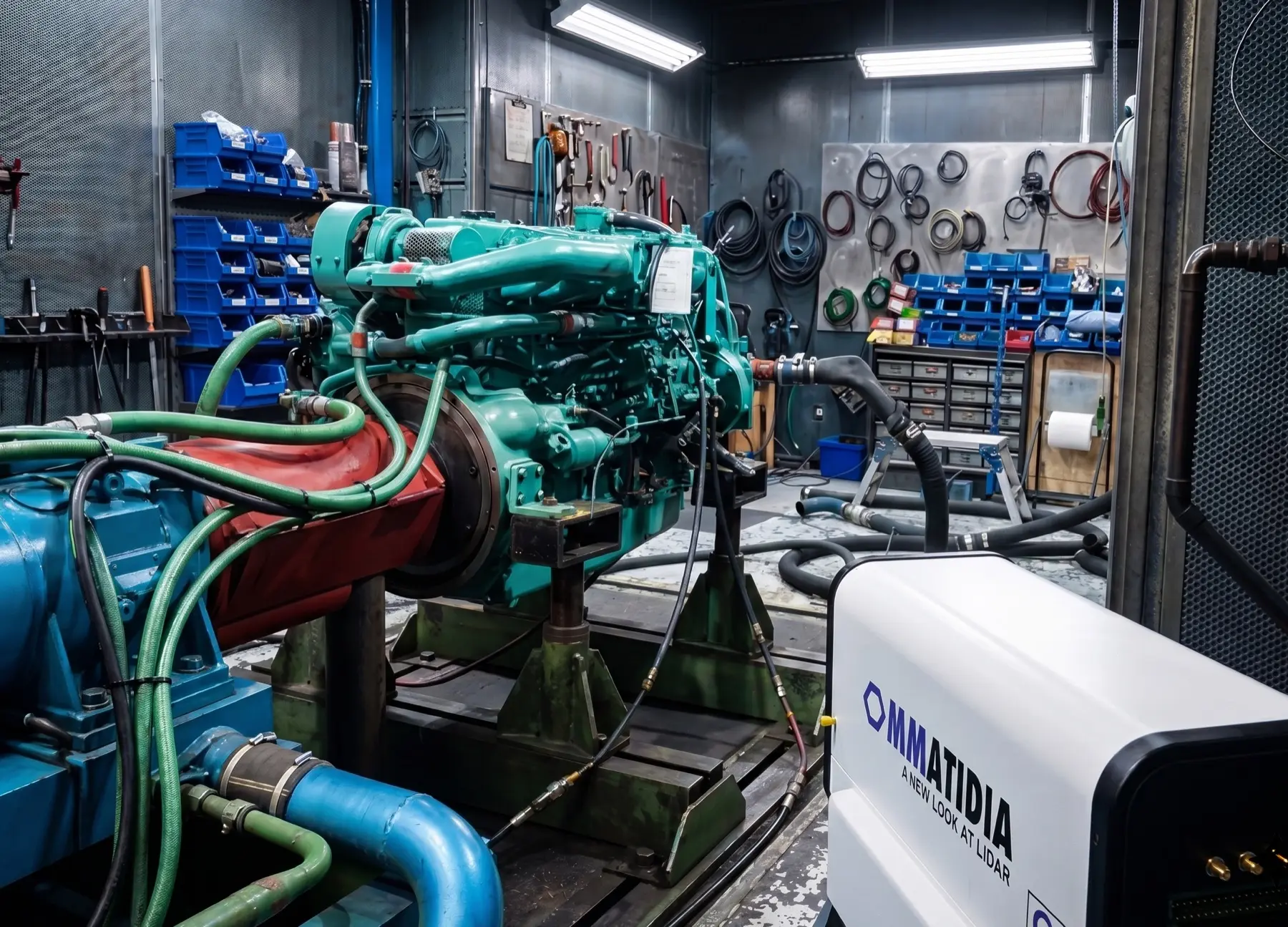
Vibrométrie du moteur diesel Doosan L136T à l’École d’ingénierie navale de l’UPM

Vibrométrie laser plein champ pour l'analyse des vibrations de moteur diesel, le développement de bancs d'essai et la surveillance de l'état.
27 juillet 2026
Categories
  • Non catégorisé

Ommatidia contribue à l’emploi des jeunes en Europe

Ommatidia forme la prochaine génération européenne de talents en photonique et en deep-tech en créant des postes qualifiés en optique, électronique, logiciel et ingénierie de test. Cet effort de recrutement est soutenu par le Fonds social européen plus (FSE+) via le programme pour l’emploi des jeunes de la Communauté de Madrid, cofinancé à 40 %.

info@ommatidia-lidar.com

ES : +34 610 012 748

Avenida de los Labradores 1
28760 Tres Cantos - Madrid (ESPAGNE)

NL : +31 624 888849

De Loods Building
Treubstraat 27
2288EH Rijswijk (PAYS-BAS)

CN : Bureau de Suzhou

Building D, Sino-Dutch Innovation Port
No. 588 Xiangrong Road
Xiangcheng District, Suzhou, Jiangsu

Suivez-nous !

YouTube

Contactez-nous pour en savoir plus.

    Le responsable de la protection des données des utilisateurs qui envoient leurs informations via ce formulaire est Ommatidia. Nous collectons les données de ce formulaire afin de répondre à la demande d’information des utilisateurs. Si certaines informations personnelles ne doivent pas être connues, nous vous recommandons de ne pas les inclure dans ce formulaire. La base juridique principale est le consentement de la personne concernée.

    Les destinataires de ces données sont les membres de l’équipe Ommatidia. Si vous incluez votre adresse e-mail dans les données que vous nous fournissez, vous pouvez demander que nous vous envoyions une copie du message qui nous parviendra.

    • À propos d’Ommatidia
    • Marchés
      • Espace
      • Métrologie industrielle et contrôle de processus
      • Énergie
      • Construction et génie civil
      • Acoustique, bruit et vibrations
    • Technologie
      • Technologie
    • Produits
      • Single-beam LDVs
        • SpeedSync
        • Vibromètre laser mono-point QMini
      • RADAR laser parallèles
        • Laser RADAR Q1S
        • Q1 · Balayage
      • Logiciel Q-Series
        • Atelier
        • OmmH5Viewer
    • Services
      • OmmRent
      • OmmService
    • Distributeurs agréés
      • Nos clients
    • Actualités de la vibrométrie
    • Notes d’application
    • Talk to an applications engineer

    info@ommatidia-lidar.com

    ES : +34 610 012 748

    Avenida de los Labradores 1, bureau 4.7
    28760 Tres Cantos ESPAGNE

    NL : +31 624 888849

    De Loods Building Treubstraat 27, 2288EH Rijswijk PAYS-BAS

    CN : Bureau de Suzhou

    Building D, Sino-Dutch Innovation Port
    No. 588 Xiangrong Road
    Xiangcheng District, Suzhou, Jiangsu

    Financiado por la Union Europea
    Plan de Recuperación, Transformación y Resiliencia
    MINISTERIO DE AGRICULTURA, PESCA Y ALIMENTACIÓN
    MINISTERIO DE INDUSTRIA, COMERCIO Y TURISMO

    Subventionné par le CDTI

    • Mentions légales
    • Déclaration de confidentialité
    • Politique en matière de cookies
    • Avis de non-responsabilité

    Copyright © 2026 Ommatidia LiDAR S.L. Tous droits réservés.

    Contactez-nous
    Français
    • English
    • Español
    • Deutsch
    • Italiano
    • 日本語
    • 한국어
    • Português
    • Nederlands
    • 简体中文
    • Français
      Ommatidia support Get expert advice

      Our AI will connect you with expert advice.

      Preparing your AI assistant…
      Gestiona tu privacidad
      Utilizamos tecnologías como las cookies para almacenar y/o acceder a la información del dispositivo. Lo hacemos para mejorar la experiencia de navegación y para mostrar anuncios personalizados. El consentimiento a estas tecnologías nos permitirá procesar datos como el comportamiento de navegación o los ID's únicos en este sitio. No consentir o retirar el consentimiento, puede afectar negativamente a ciertas características y funciones.
      Funcionales Toujours activé
      El almacenamiento o acceso técnico es estrictamente necesario para el propósito legítimo de permitir el uso de un servicio específico explícitamente solicitado por el abonado o usuario, o con el único propósito de llevar a cabo la transmisión de una comunicación a través de una red de comunicaciones electrónicas.
      Preferencias
      El almacenamiento o acceso técnico es necesario para la finalidad legítima de almacenar preferencias no solicitadas por el abonado o usuario.
      Analíticas
      El almacenamiento o acceso técnico que es utilizado exclusivamente con fines estadísticos. El almacenamiento o acceso técnico que es utilizado exclusivamente con fines estadísticos anónimos. Sin una requerimiento, el cumplimiento voluntario por parte de su proveedor de servicios de Internet, o los registros adicionales de un tercero, la información almacenada o recuperada sólo para este propósito no se puede utilizar para identificarlo.
      Seguimiento
      El almacenamiento o acceso técnico es necesario para crear perfiles de usuario para enviar publicidad, o para rastrear al usuario en un sitio web o en varios sitios web con fines de marketing similares.
      • Paramètres des cookies
      • Gérer les services
      • Gérer {vendor_count} fournisseurs
      • En savoir plus sur ces finalités
      Administrar opciones
      • {title}
      • {title}
      • {title}
      Gestiona tu privacidad
      Utilizamos cookies para optimizar nuestro sitio web y nuestro servicio.
      Funcionales Toujours activé
      El almacenamiento o acceso técnico es estrictamente necesario para el propósito legítimo de permitir el uso de un servicio específico explícitamente solicitado por el abonado o usuario, o con el único propósito de llevar a cabo la transmisión de una comunicación a través de una red de comunicaciones electrónicas.
      Preferencias
      El almacenamiento o acceso técnico es necesario para la finalidad legítima de almacenar preferencias no solicitadas por el abonado o usuario.
      Analíticas
      El almacenamiento o acceso técnico que es utilizado exclusivamente con fines estadísticos. El almacenamiento o acceso técnico que es utilizado exclusivamente con fines estadísticos anónimos. Sin una requerimiento, el cumplimiento voluntario por parte de su proveedor de servicios de Internet, o los registros adicionales de un tercero, la información almacenada o recuperada sólo para este propósito no se puede utilizar para identificarlo.
      Seguimiento
      El almacenamiento o acceso técnico es necesario para crear perfiles de usuario para enviar publicidad, o para rastrear al usuario en un sitio web o en varios sitios web con fines de marketing similares.
      • Paramètres des cookies
      • Gérer les services
      • Gérer {vendor_count} fournisseurs
      • En savoir plus sur ces finalités
      Administrar opciones
      • {title}
      • {title}
      • {title}