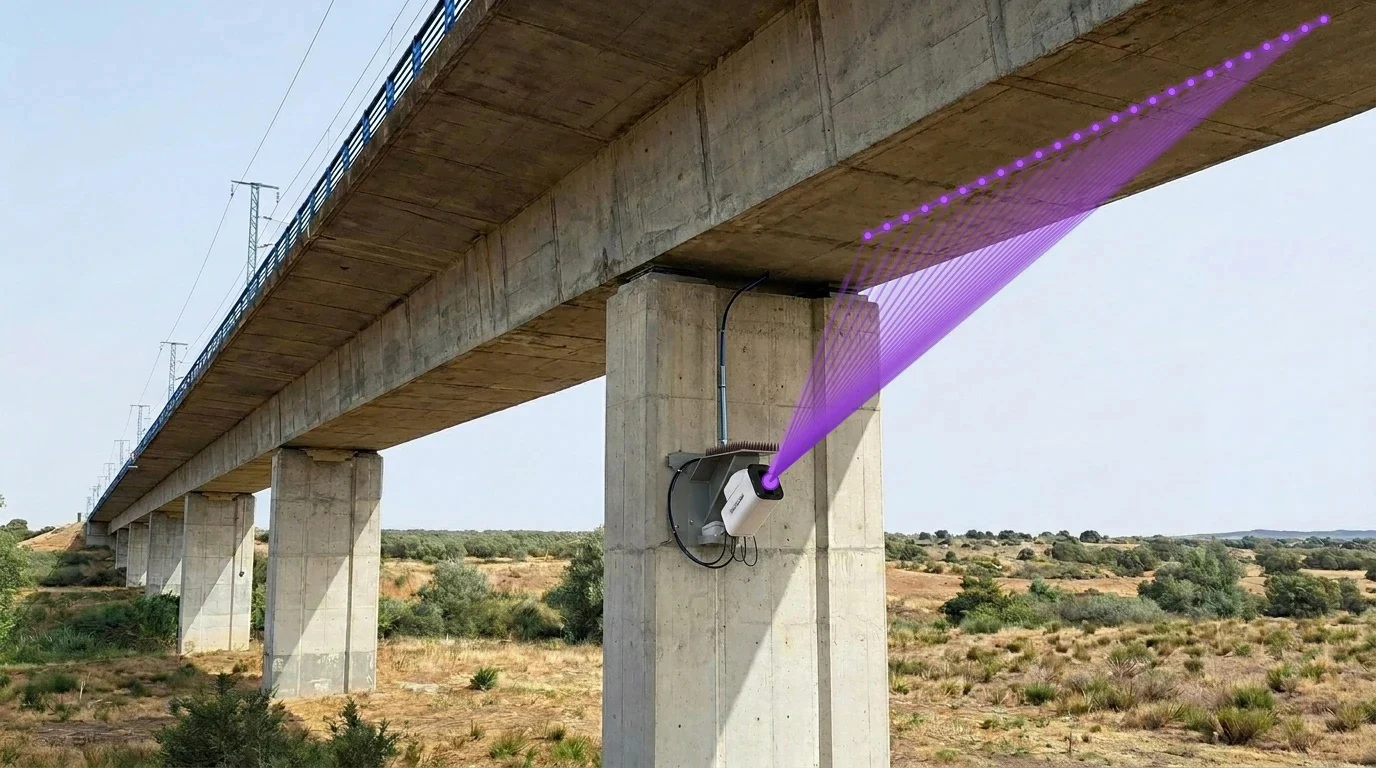
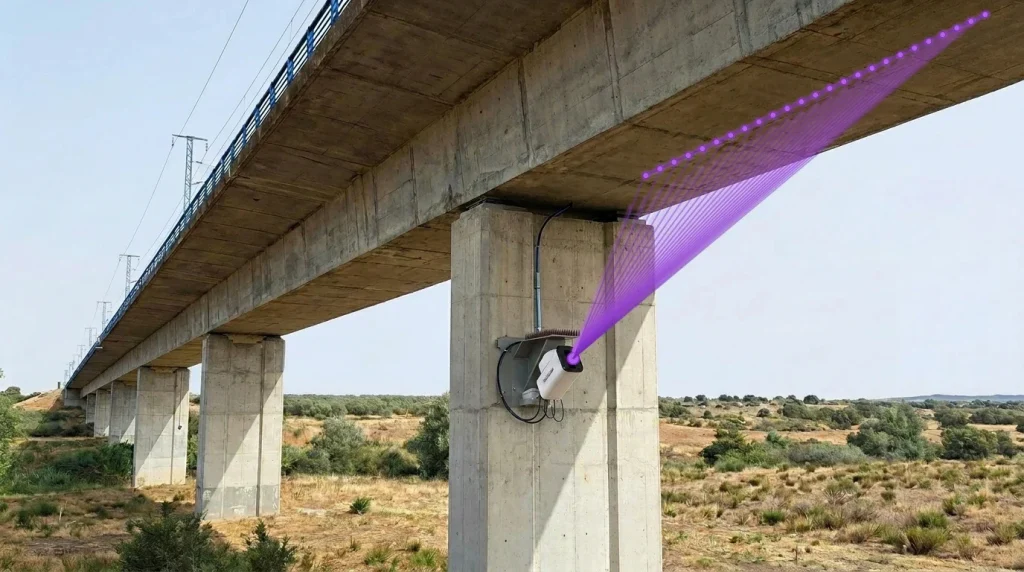
Vibrométrie et métrologie 3D pour l’évaluation de l’état des infrastructures énergétiques.

Priorisez la dynamique des éoliennes, la vibroacoustique des transformateurs et l’inspection des grands actifs. Comparez les configurations de la série Q et discutez du plan de mesure avec un ingénieur d’application.

L'amélioration de la fiabilité des infrastructures énergétiques nécessite une surveillance et une maintenance préventives. Cela inclut l'exploitation de l'analyse vibroacoustique pour l'atténuation du bruit dans les transformateurs, l'analyse des vibrations à haute résolution pour les éoliennes, et la surveillance de l'intégrité structurelle pour les barrages, les centrales électriques et au-delà.

Découvrez comment le radar laser FMCW d'Ommatidia transforme la surveillance du secteur de l'énergie, de la certification et de la maintenance à l'analyse prédictive — garantissant une sécurité accrue et des opérations continues du réseau électrique.

Capture de données efficace

Les solutions LiDAR d'Ommatidia sont conçues pour les opérations en extérieur et en intérieur. Grâce à leur longue portée, les radars laser de la série Q peuvent être facilement déployés même dans des conditions d'accès difficiles. De plus, le poids léger et la petite taille de nos solutions permettent un transport simple sur site.

Logiciel Atelier

Ommatidia Atelier 8.0 est une solution complète pour gérer les données de nos scanners 3D et pour prendre en charge la connexion des sources sur le terrain à différentes interfaces standard de l'industrie et logiciels de gestion.

Avantages

  • Analyse dynamique complète

    Les systèmes Q capturent des données détaillées de vibration et de déplacement, prenant en charge l'analyse modale opérationnelle (OMA) pour identifier les fréquences naturelles, les formes modales et l'amortissement structurel.

  • Informations structurelles en temps réel

    Surveillez en continu les performances structurelles, permettant la détection précoce de l'usure, de la fatigue ou des dommages pour une sécurité et une fiabilité accrues.

  • Capacités de mesure de précision

    Le système détecte les micro-déplacements et les changements de vitesse avec une précision supérieure à 0,1 mm, en utilisant la vélocimétrie laser Doppler et une illumination continue à une longueur d'onde de 1550 nm.

  • Évolutif et polyvalent

    Des éoliennes aux réacteurs nucléaires, le système Q1 est adaptable à diverses applications du secteur de l'énergie, prenant en charge les besoins de surveillance dynamique et statique.

  • Prêt pour l'Industrie 4.0

    Avec la synchronisation GPS et l'intégration cloud, le système facilite l'accès aux données à distance et l'analyse avancée, s'alignant sur l'infrastructure numérique moderne.

Applications dans les infrastructures énergétiques

Éoliennes

  • Surveillance en temps réel du comportement dynamique sous charges opérationnelles.

  • Analyse modale pour évaluer les modes de vibration et les déflexions structurelles.

  • Informations pour la maintenance préventive afin de prolonger la durée de vie des turbines et d'améliorer l'efficacité.

Installations nucléaires

  • Surveillance non invasive des vibrations et des déflexions dans les composants critiques.

  • SHM continu pour une sécurité accrue et une conformité aux normes strictes.

Barrages hydroélectriques et structures énergétiques

  • Suivi des performances structurelles dans des conditions environnementales et opérationnelles variables.

  • Détection précoce des défauts pour une maintenance rapide et une assurance qualité.

Découvrez nos produits

Vous souhaitez en savoir plus ?

Suivez-nous sur LinkedIn et Twitter pour les dernières mises à jour et innovations en matière de technologie de mobilité autonome. Ou contactez-nous pour vos questions.

SEE MORE · KNOW MORE

Energy vibration monitoring

Get the motion, shape and vibration evidence you need for wind-turbine blades, transformers and hard-to-access energy assets.
Measure more of the structure with less instrumentation. Combine non-contact 3D metrology and laser Doppler vibrometry in one field-ready workflow.

Built for: blade testing · turbine dynamics · transformer diagnostics

WHERE TO FOCUS

Focus the measurement on the assets that matter

Energy assets are large, distributed and difficult to instrument. A stand-off, multi-point workflow helps teams capture the spatial context behind a vibration signal, whether the job is validation, troubleshooting, certification support or preventive maintenance.

Turbine response in operation

Track structural response through changing wind, rotor speed, pitch and operating conditions—with spatial evidence that supports the engineering decision.

Blade qualification and fatigue testing

Capture 3D deflection, curvature and local strain behaviour during static-load, resonance and fatigue campaigns—without loading the blade with a dense sensor installation.

Transformer vibroacoustics

Map vibration remotely on transformers and shunt reactors to support anomaly investigation, preventive maintenance and repeatable screening workflows.

BLADE TESTING

Wind-turbine blade testing: in the lab and the field

Blade teams need one measurement approach that carries from static-load, resonance and fatigue rigs to field investigations on operating turbines. In the lab, capture 3D deflection vectors across the blade, resolve curvature change and map local strain for model correlation and qualification evidence.

In the field, relate structural response to rotor speed, pitch, wind and operating state. Stand-off acquisition keeps the instrument off the test article and gives the team repeatable coverage when access is limited.

WHAT YOU CAN MEASURE

Turn blade motion into structural insight

3D deflection vectors

Capture motion across the blade in three dimensions, not just a single tip or spanwise displacement.

Local curvature

Resolve changes in the blade shape along the span and around critical structural features under load.

Local strain maps

Use the measured spatial response to identify local strain behaviour for correlation, fatigue assessment and design validation.

Lab and field coverage

Apply the same non-contact approach to qualification testing, fatigue campaigns and in-service blade-response investigations.

PROVEN WORKFLOWS

Explore the technical evidence

Connect this page to concrete Ommatidia measurement work—wind-turbine tower dynamics, transformer health monitoring and field-ready industrial diagnostics.

Wind Turbine Tower monitoring

Read the application note on structural-vibration measurement in a real wind-turbine tower, under operational and non-operational conditions.

Transformer health monitoring

Review the Q2 Laser RADAR application note for non-contact, stand-off vibration mapping on transformers and shunt reactors.

Field-ready transformer diagnostics

See an Ommatidia deployment across operational testbeds, from buzzing transformers to high-frequency electric motors.

CHOOSE YOUR PLATFORM

Choose the right Q-series configuration

Keep the measurement method aligned with the access conditions, spatial coverage and test objective. Our applications team can help choose the appropriate Q-series system for your campaign.

Q1 Laser RADAR

Portable Laser RADAR for stand-off field measurements and multi-point structural-dynamics campaigns.

Q2 Laser RADAR

Massively parallel measurement for dense, non-contact geometry and vibration data on complex components.

Q1S Laser RADAR

A fixed-installation option for continuous non-contact monitoring of critical infrastructure and equipment.
COMMON QUESTIONS

Energy vibration monitoring: common questions

Ommatidia Laser RADAR is designed for non-contact, stand-off measurement. The appropriate configuration and setup depend on the access conditions, line of sight, required spatial coverage and dynamics of the asset.

It gives the team 3D deflection vectors across the blade, plus curvature and local strain insight where the structure needs closer attention. That spatial evidence strengthens modal work, model correlation, qualification and fatigue decisions.

Remote vibration mapping can support transformer and shunt-reactor anomaly investigation, preventive maintenance and repeatable screening without attaching a dense set of contact sensors to the asset.

Ommatidia Laser RADAR systems combine non-contact 3D geometry measurement with laser Doppler vibrometry capabilities. The exact workflow depends on the product and measurement mode selected for the application.

The selection depends on the campaign: distance, field access, spatial density, operating environment and whether the objective is a campaign measurement or a continuous installation. Discussing the application with our team is the fastest way to scope the right configuration.

Fatigue testing applies controlled cyclic loading to demonstrate blade reliability and service life. Ommatidia adds full-field evidence: 3D deflection vectors, curvature change, vibration response and local strain behaviour across the areas that matter.

Laser RADAR measures the blade from a stand-off position, so the test article stays free of a dense sensor installation. The result is spatial 3D displacement data that shows deflection and shape change across the blade, rather than at only a few instrumented points.

It connects the blade’s structural response with the operating context: rotor speed, pitch, wind and load state. Repeatable non-contact measurements help teams compare behaviour over time, investigate unusual response and focus follow-up work where the data shows a change.

NEXT STEP

Plan a more complete energy measurement campaign

Tell us the asset, access constraints and the response you need to understand. We will help you define the right non-contact workflow and Q-series configuration.