
Laser RADAR vs Accelerometers

Compare accelerometers and Ommatidia Laser RADAR for low-frequency vibration, displacement, bridge deflection, automotive NVH, and hard-to-instrument structures.
Best fit for teams weighing contact sensors against stand-off measurement where access, heat, mass loading, installation time, or sparse point coverage limit the test.
iStock 2207157951
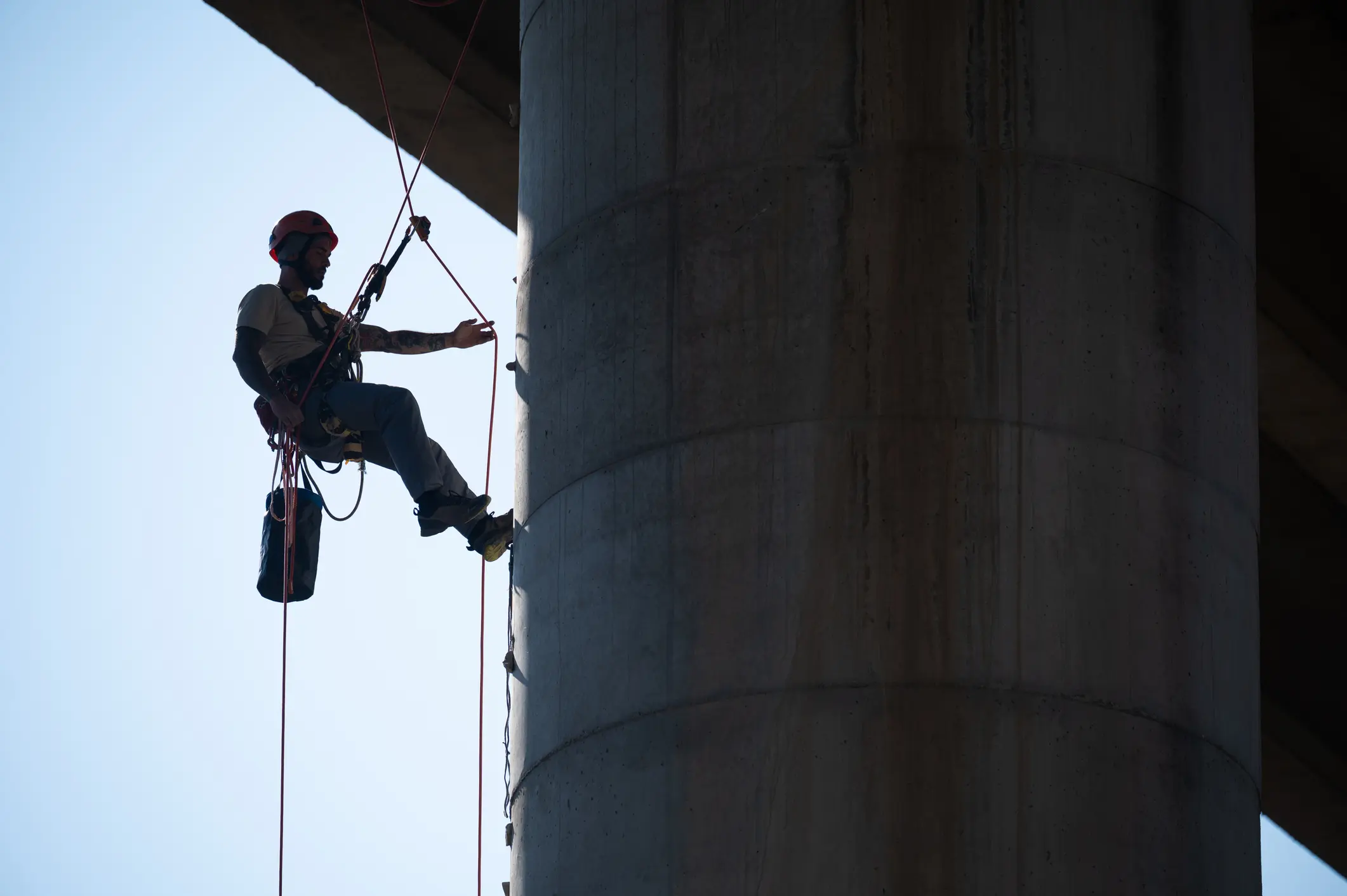
Rope-access bridge inspection highlights the access, safety, and setup needs that often make remote measurement more practical than dense contact instrumentation.

Choose by the measurement bottleneck

Accelerometers fit when local point data is enough

Keep them when the structure is accessible, the point list is short, and mounting effort is acceptable.

Laser RADAR fits when setup and access dominate

Remote measurement becomes stronger when live assets, safety rules, or access limits make dense contact instrumentation slow or disruptive.

Laser RADAR fits when low-frequency displacement matters

Track structural behaviour to DC and derive displacement with one integration instead of offset-prone double integration.

Laser RADAR fits when high-temperature sensors do not solve deployment

High-temperature accelerometers exist, but they do not remove contact mounting, cabling, survivability, and maintenance effort.

The short answer

Accelerometers remain useful when the structure is accessible, the measurement is local, and installation effort is not the main cost driver.
Laser RADAR becomes the stronger path when low-frequency behaviour, displacement, access, mass loading, field practicality, or dense spatial coverage dominate the test.

Cleaner low-frequency behaviour

Measure response all the way to DC without the drift that can distort low-frequency interpretation in offset-sensitive acceleration workflows.

Displacement with one integration

Derive displacement from velocity with one integration instead of relying on double integration that can accumulate offset and drift.

Dense multi-beam sampling

Richer spatial coverage gives the engineering team more evidence than a sparse contact-sensor grid can provide.

High-temperature sensors do not remove deployment burden

Even when hot-environment accelerometers survive, the contact workflow still carries mounting, cable, and access costs.

Why dense multi-beam sampling changes the processing path

Dense multi-beam sampling is not only a setup advantage. It changes what the analysis chain can support when the engineering team needs richer structural interpretation than sparse point instrumentation can deliver.
That matters when advanced processing schemes such as deconvolution, response separation, or strain calculation from richer displacement fields depend on dense spatial information instead of a short list of accelerometer locations.

Deconvolution and response separation

Denser measurement geometry gives advanced processing schemes more usable spatial evidence when vibration sources overlap.

Strain-oriented displacement workflows

Use richer displacement fields when interpretation depends on distributed motion rather than local acceleration alone.

Bridge and automotive relevance

The same advantage matters in bridge response, footbridge dynamics, and automotive NVH when a few mounted points are not enough.

Laser RADAR and accelerometers compared

This comparison helps teams choose between contact accelerometers and stand-off Laser RADAR when low-frequency displacement quality, installation effort, access, and dense spatial sampling matter.

External references: FHWA on wireless bridge sensor systems, FHWA on structural health monitoring for highway bridges, and NASA NTRS background on accelerometer integration error sensitivity.

Decision dimensionAccelerometersOmmatidia Laser RADAR
Installation effortRequires sensor mounting, cabling, and repeated access.Stand-off setup avoids dense contact instrumentation on the structure.
Spatial coverageBest for local point response unless the team scales into dense arrays.Better when the question needs wider structural or vehicle-surface response.
Low-frequency behaviourDisplacement interpretation can become more offset-sensitive.Follows low-frequency behaviour to DC with cleaner displacement framing.
Displacement workflowOften depends on processing choices that can accumulate offset.Derives displacement from velocity with one integration.
Advanced processing headroomSparse point layouts limit what downstream spatial processing can support.Dense multi-beam sampling is a stronger base for deconvolution and strain-oriented workflows.
Heat and difficult deploymentHigh-temperature variants exist, but contact mounting and wiring remain.Better when the real limitation is difficult deployment rather than sensor survivability alone.
iStock 1022530806
Bridge underside geometry and access needs reinforce why remote measurement workflows are often easier to deploy than dense contact instrumentation.

Proof from bridge and automotive work

La Marota viaduct

Bridge-monitoring evidence where Laser RADAR results aligned with accelerometer data and captured deflection without dense contact instrumentation.

Santa Eugenia footbridge

Field measurement on a live footbridge without traffic interruption, useful when access and deployment time matter.

Automotive NVH response mapping

Automotive NVH mapping examples show why dense non-contact measurement can replace large accelerometer arrays on complex surfaces.

Low-frequency displacement review

Relevant when low-frequency displacement interpretation is central to structural response review.

Review your instrumentation needs with Ommatidia

If mounting effort, low-frequency displacement, or target access is limiting your current setup, Ommatidia can review the structure, range, temperature conditions, and response data you need.

Laser RADAR and accelerometer questions

Choose the measurement mix from the structure, event and required evidence.

When is Laser RADAR preferable to accelerometers?

Laser RADAR is attractive when access, sensor mass, cabling or setup time limits contact instrumentation, or when many spatially distributed responses must be measured from a stand-off position. Accelerometers remain effective for fixed local points, embedded monitoring and locations without a usable optical line of sight.

Does non-contact vibrometry replace accelerometers in every test?

No. The methods are complementary. Optical measurement can reduce contact setup and add dense spatial coverage, while accelerometers can provide local references, operate where optical return is poor and support long-duration installed monitoring. A hybrid test is often the most defensible choice.

What must match when comparing optical velocity with acceleration?

Match the measurement location and direction, coordinate sign, timing, sample rate, bandwidth, filters and units. For sinusoidal motion, acceleration and velocity are related by a = 2πf v. Broadband conversion needs appropriate integration or differentiation and documented processing, not only a unit change.

Can either method certify structural safety by itself?

No. Both provide measurement evidence. Safety, conformity or remaining-life conclusions require a defined test plan, calibration and uncertainty controls, operating and boundary conditions, an accepted analysis method and qualified engineering review. The sensor choice alone does not establish certification.