How Laser RADAR Improves Bridge Structural Health Monitoring
Structural Health Monitoring (SHM) is essential for ensuring the safety and longevity of bridge infrastructure. Traditional methods, while effective, often involve contact-based sensors and manual inspections, which can be time-consuming and sometimes insufficient for capturing comprehensive data. Laser RADAR technology has emerged as a transformative tool in this domain, offering non-contact, precise, and efficient monitoring capabilities that surpass conventional techniques.
Planning a bridge monitoring project?
Share the span, working distance and result you need—vibration, deflection, modal response or geometry. An applications engineer will help define the practical measurement approach.
Advancements in Vibration Analysis with Laser RADAR
Comprehensive Vibration Analysis and Deflection Measurement for Enhanced Structural Integrity Assessment
Vibration analysis is a cornerstone of SHM, providing insights into a structure's dynamic behavior and potential anomalies. Traditional tools like accelerometers and Laser Doppler Vibrometers (LDVs) have been employed for this purpose. However, LDVs primarily measure velocity and require a reference point, limiting their ability to capture absolute deflections and distances. Laser RADAR technology addresses these limitations by enabling the measurement of both deflection and vibration, along with absolute distance measurements on solid structures.
This capability allows for a more comprehensive understanding of a bridge's structural behavior under various loads and environmental conditions. For instance, during load testing, Laser RADAR can simultaneously capture the bridge's vibrational response and precise deflection profiles over long periods of time, facilitating a holistic assessment of structural integrity.
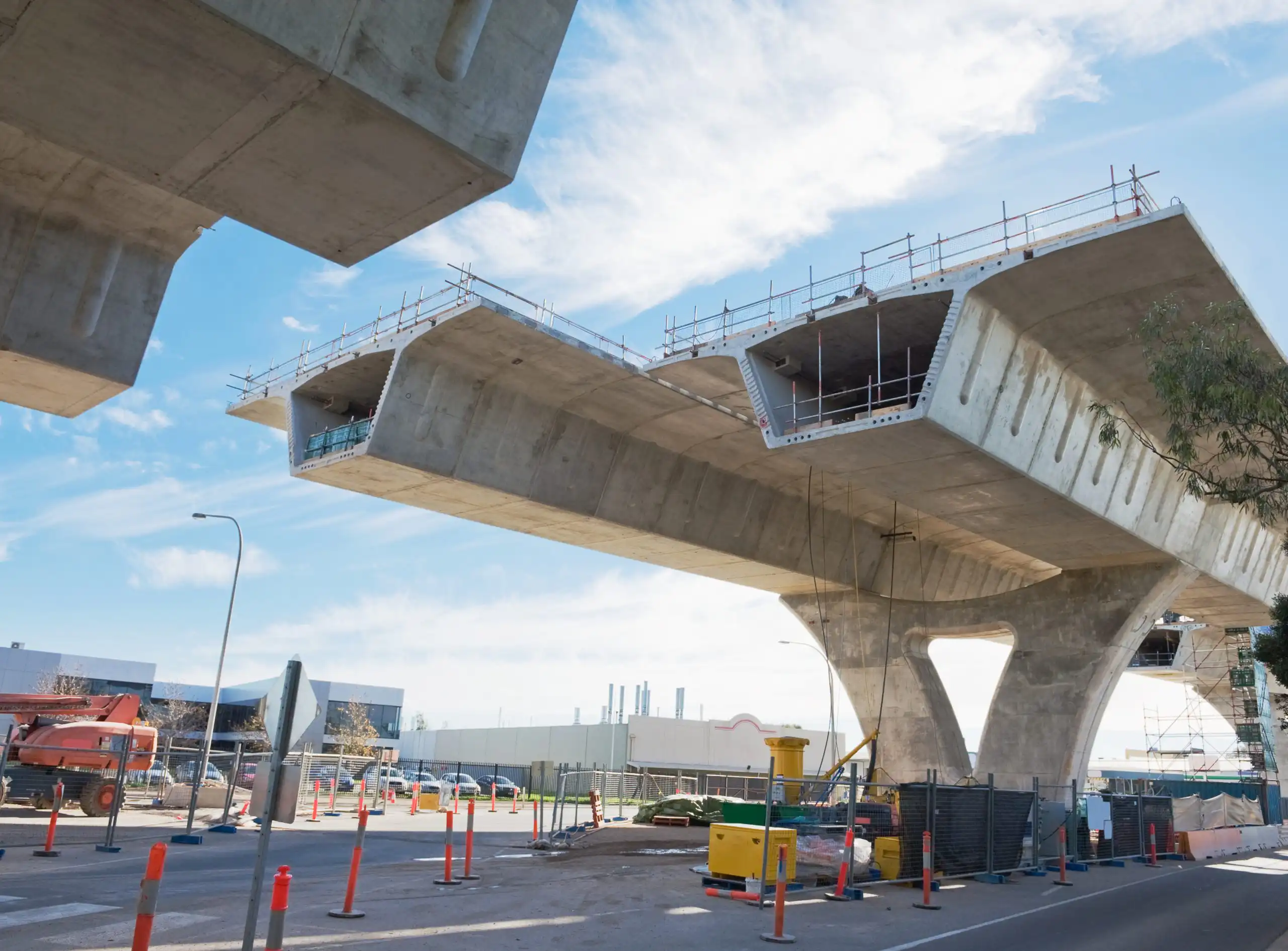
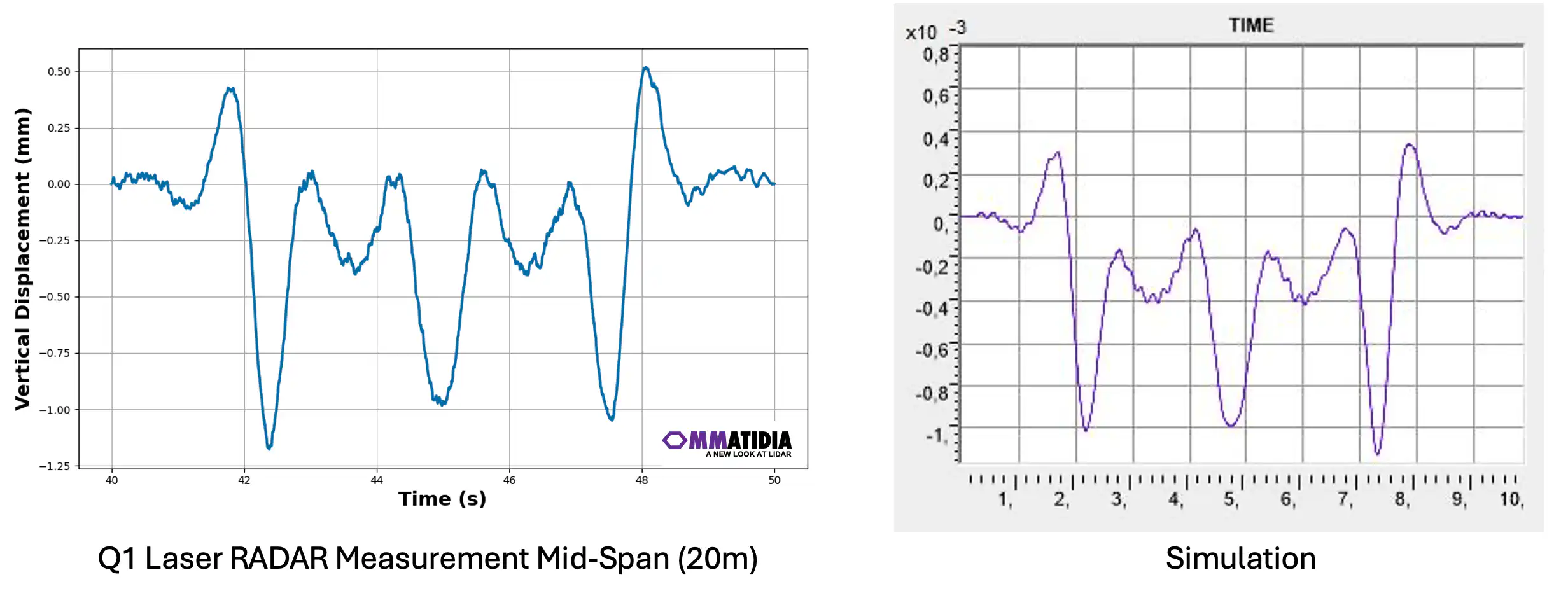
Measurements Obtained in a Continuous Monitoring Installation of Mid-Span Bridge Deformation Compared With Simulations
Real Time Monitoring of Viaducts and Bridges
The application of Laser RADAR in bridge monitoring has demonstrated significant advantages. In a study focusing on vibration-based SHM, Laser RADAR was utilized to measure the dynamic responses of bridge cables, providing accurate data that correlated well with traditional contact sensors. This non-contact approach reduced measurement time and enhanced safety by eliminating the need for physical access to the structure.
Ground-based radar interferometry is a related tool for bridge monitoring. This technique shares the ability to capture a bridge's natural frequencies and mode shapes without direct contact, but lacks absolute precision and is more limited in spatial resolution and relative accuracy.
Limitations of Total Station in SHM
Total stations monitor bridge deformation with >1mm accuracy. However, they require prisms and are limited in capturing dynamics. Laser RADAR solves these limitations:
- Non-Contact Measurement: Eliminates the need for physical targets or prisms, reducing setup time and potential safety hazards.
- Dynamic Monitoring: Capable of capturing real-time vibrational data, essential for assessing structural responses to dynamic loads.
- Comprehensive Data Acquisition: Simultaneously measures deflection, vibration, and absolute distances, offering a more complete structural assessment.
These advantages make Laser RADAR a superior choice for comprehensive bridge monitoring, providing data that is both precise and encompassing.
Efficiency & Safety of Massively Parallel Laser
Ommatidia's Laser RADAR systems are at the forefront of SHM technology, offering several key benefits:
- Early Damage Detection: High-resolution measurements enable the identification of minor structural changes before they escalate into critical issues, allowing for proactive maintenance.
- Reduced Inspection Times: Non-contact measurements can be conducted rapidly without the need for extensive setup or traffic disruptions, minimizing downtime and associated costs.
- Improved Data Accuracy: The ability to measure absolute distances and deflections provides precise data, enhancing the reliability of structural assessments.
- Safety Enhancement: Remote monitoring capabilities reduce the need for personnel to access hazardous areas, thereby improving overall safety during inspections.
Conclusions
1
Advanced Technology:
Laser RADAR technology provides unparalleled precision in monitoring bridge structures by capturing both vibrational and deflection data, along with absolute distance measurements. This comprehensive approach overcomes the limitations of traditional tools, such as accelerometers and LDVs, which often rely on contact-based measurements and reference points. By offering a complete picture of structural behavior, Laser RADAR enables engineers to make more informed decisions about maintenance and safety.
2
Enhanced Safety and Maintenance Efficiency:
With non-contact measurement capabilities, Laser RADAR eliminates the need for manual installation in hazardous areas. This not only reduces costs and risks for personnel but also minimizes disruptions to traffic and operations during assessments. Additionally, the technology allows for early detection of structural anomalies, enabling proactive maintenance and avoiding costly repairs or catastrophic failures.
3
Innovative Solutions from Ommatidia:
Ommatidia's cutting-edge Laser RADAR systems bring this advanced technology to practical applications. Their systems are designed to deliver high-resolution, accurate data tailored to the unique challenges of bridge monitoring, ensuring reliable performance in diverse conditions.
4
Revolutionizing Bridge Monitoring Practices:
By addressing critical gaps in current methods, Laser RADAR technology represents a transformative step forward in Structural Health Monitoring. It ensures the longevity and reliability of bridges, supporting safer and more efficient infrastructure management.
Did You Know?
Laser RADAR technology revolutionizes bridge monitoring by capturing both long-term shifts, deflections and vibrations without contact. Unlike traditional tools, it measures absolute distances and dynamic responses, offering unparalleled precision and safety for Structural Health Monitoring.
Bridge structural-health-monitoring questions
Start with the engineering decision and measurement conditions, then select the optical and reference channels.
What can Laser RADAR measure on a bridge?
A coherent Laser RADAR workflow can combine absolute distance with non-contact surface velocity and derived displacement over optically accessible points. This supports deflection profiles, dynamic-response maps and repeated comparisons. The required quantity, geometry, bandwidth and uncertainty must be specified before choosing the measurement configuration.
How does optical monitoring complement contact sensors?
Optical measurement can cover accessible points without installing and wiring a sensor at each location. Accelerometers, displacement transducers or other references can still provide control, traceability and evidence at hidden or optically difficult points. A hybrid plan should align coordinates, timing, bandwidth and uncertainty.
What information is needed to plan a bridge measurement?
Define the span and surfaces, stand-off, line of sight, expected displacement and velocity, frequency band, spatial density, traffic or test load, weather and operating conditions, reference channels, synchronization, duration, repeatability and the required engineering output. Confirm optical return on the real surface before relying on a long-term setup.
Does a Laser RADAR result replace inspection or structural assessment?
No. It supplies distance, deflection and vibration evidence for a defined measurement state. Structural interpretation still belongs in the applicable inspection and engineering process, using a validated model, known loads and boundaries, uncertainty, corroborating evidence and project-specific acceptance criteria.