

Join Ommatidia along with hundreds of experts in acoustics and vibrometry at DAS / DAGA 2025—the joint annual meeting of the German and Danish Acoustical Societies—taking place at Copenhagen’s Bella Centre from March 17-20, 2025.
This marks the first time, Ommatidia is presenting its groundbreaking Massively Parallel Laser Radar technology and its transformative applications in acoustics, 3D vibrometry, and metrology to a wider audience in Scandinavia.

Introducing the Q-Series Laser Radar – A New Standard in Acoustics & Vibrometry
The Q-Series Laser Radars set a new industry benchmark by seamlessly integrating in a single device
✅ Long-range interferometry
✅ Laser Doppler Vibrometry
✅ Micron-level metrology
What makes the Q-Series unique is its ability to leverage a massively parallel laser architecture—for the first time ever—to enable simultaneous measurements across multiple channels. This results in over 10× greater efficiency compared to traditional single-point Laser Doppler Vibrometers.
The Q2 Laser Radar is ideal for a wide range of industrial applications, delivering high-precision dimensional velocimetry data for real-time system monitoring and advanced analytics through seamless integration with third-party software and infrastructures.
Powered by World's First Photonic Integrated Circuit (PIC)
Ommatidia's expertise and proprietary technologies empowers our multi-channel FMCW laser. The Q-series enables non-destructive testing (NDT) advanced vibrometry and micron-level metrology in a simple-to-use device.
Massively Parallel Q Laser Radar in Acoustic & 3D Vibrometry
The Q2 Laser Radar revolutionizes long-range vibrometry and acoustic testing by combining micron-level 3D metrology with advanced vibration analysis in a single, versatile tool.
With a lightweight design (< 7 kg) and easy installation on static or mobile metrology tripods and custom setups, it streamlines workflows by replacing multiple instruments—delivering unmatched precision and efficiency in both static and dynamic applications.
Q2 Key Performance & NEW Features
🔹 Measurement Range: 1.0m to 50m
🔹 Exceptional Accuracy: Down to 20μm +6 μm/m – exceeding conventional laser scanners
🔹 Acquisition Speed: 128 to 25,600 points per second, significantly reducing inspection time
🔹 Micro-scanning in Elevation & Azimuth Axes: Handles complex shapes, surfaces, and materials effortlessly
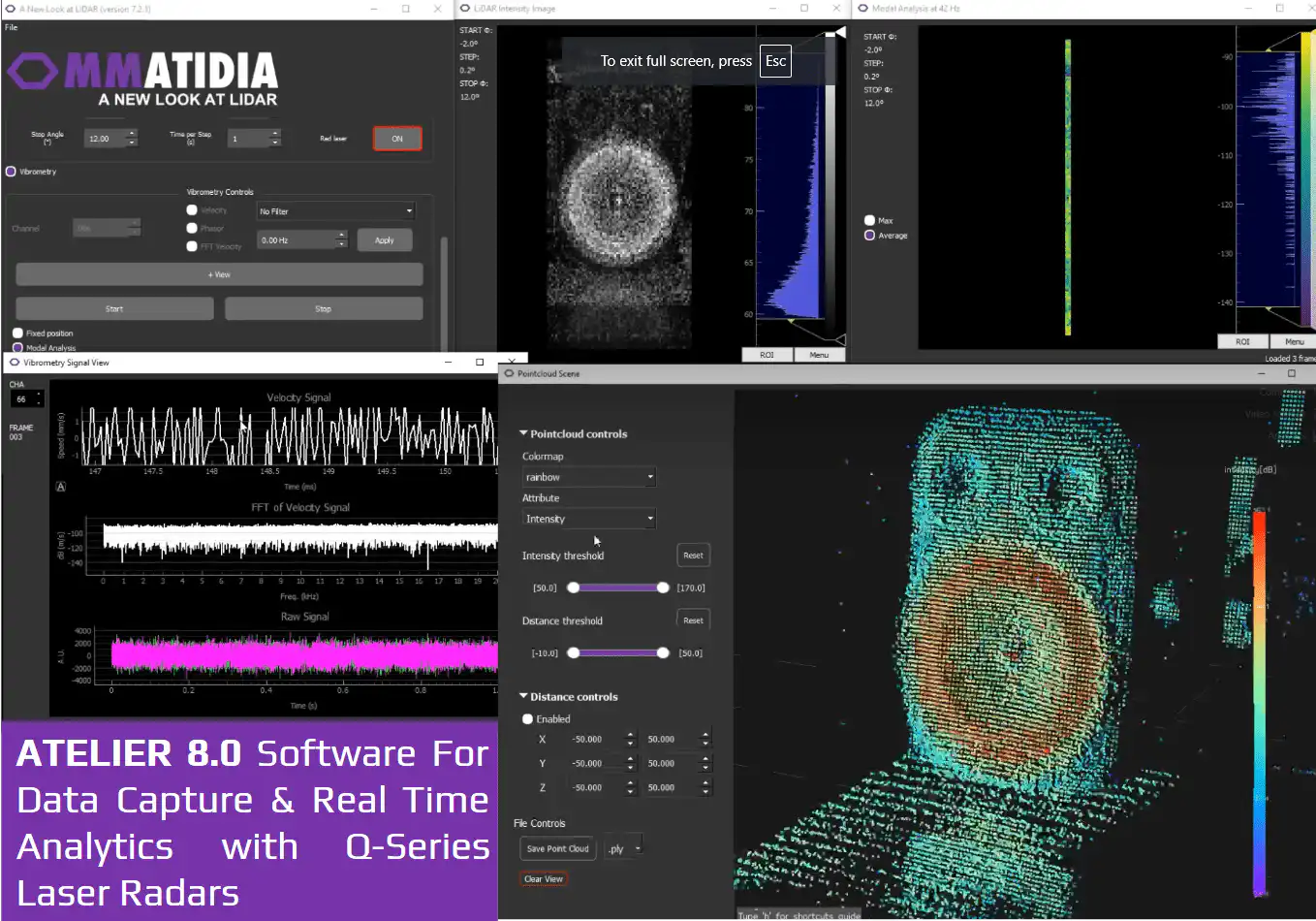
Massively Parallel FMCW Laser
The Game-Changer in 3D Vibrometry, Acoustics & Noise Control
1
NVH (Noise, Vibration, and Harshness) in Automotive Engineering
- In the automotive industry, laser doppler vibrometry (LDV) is used to analyze how structural components vibrate and contribute to overall vehicle noise.
- It helps in detecting resonance frequencies and structural-borne noise sources from panels, dashboards, doors, and engine compartments.
- LDV assists engineers in optimizing materials and design, ensuring vehicles are quieter, more comfortable, and have better acoustic insulation.
- Advanced applications include active noise cancellation system development and electric vehicle (EV) acoustics, where motor whine and road noise are key concerns due to the absence of traditional combustion engine masking noise.
2
Aircraft & Aerospace Structural Acoustics
- In aerospace engineering, LDV is used to measure the vibrational behavior of fuselage panels, wings, and engine casings, helping in reducing aeroacoustic noise and structural fatigue.
- Essential in turbine noise analysis, LDV allows engineers to measure how acoustic waves propagate through metallic and composite materials, aiding in the design of quieter and more efficient aircraft.
- By mapping vibrations across the aircraft’s surface, LDV helps identify and mitigate vibration-induced fatigue, improving the aircraft’s durability, safety, and in-flight comfort.
3
Structural Noise Control in Buildings & Architectural Acoustics
- In civil and architectural acoustics, LDV is used to analyze building panel vibrations to assess how sound is transmitted through walls, floors, and ceilings.
- Helps engineers and architects design soundproof environments for offices, concert halls, theaters, and recording studios by optimizing material selection and structural damping.
- LDV assists in predicting and mitigating structural-borne noise, such as impact noise from footsteps, machinery vibrations, and HVAC systems.
4
Industrial & Machinery Noise Reduction
- LDV plays a key role in monitoring vibrations in industrial machinery and factory environments, where excessive structural vibrations can lead to increased noise pollution and operational inefficiencies.
- Used for predictive maintenance, detecting early signs of resonance, imbalance, and material fatigue before costly failures occur.
- Helps manufacturers optimize machine enclosures and isolation techniques to minimize structural noise transmission, improving worker safety and regulatory compliance.
Ommatidia's Q1 & Q2 systems provide precise, non-contact measurement of micrometer displacements in real-time vibration analysis and for advanced analysis.


