

Revolutionizing Structural Health Monitoring with Ommatidia’s Q1 Laser Radar
Structural health monitoring (SHM) is critical for ensuring the safety and longevity of our civil engineering infrastructures. From wind turbines to bridges, and beyond, engineers need accurate, real-time data to assess the integrity of these large structures. Enter the Q1 Laser Radar from Ommatidia—a game-changing solution that is transforming how we monitor and maintain challenging civil engineering structures.
A Glimpse into the Future of SHM
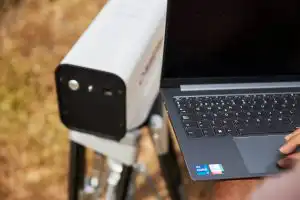
Our Q1 Laser Radar, a portable system equipped with 128 channels, utilizes Doppler vibrometry to precisely measure vibrational modes in hard-to-reach and large-scale structures. This innovative technology was recently tested at the Las Navas del Marques wind farm, where we successfully captured and analyzed the primary vibrational modes of wind turbines both in stationary conditions and while operating at 3 RPM.
The data we collected demonstrates the power of the Q1 Laser Radar in providing essential insights into the structural dynamics of large assets like wind turbines—insights that are critical to optimizing maintenance, predicting potential failures, and improving overall safety.
Non-Contact Precision for Hard-to-Reach Areas
One of the key strengths of the Q1 Laser Radar is its ability to function in environments that are typically challenging to access. With its 128 laser beams, each functioning as a non-contact accelerometer, the Q1 system can measure sub-millimetre displacements and analyze real-time vibrations without the need for cumbersome installations or complex wiring. This mobility and precision allow for seamless structural characterizations directly from the ground or nearby structures, eliminating the need for power points or overhead access.
Advancing SHM Technology with Multibeam LiDAR
The multibeam technology of the Q1 Laser Radar offers several game-changing benefits for civil engineering and other sectors:
- Dynamic and Structural Characterization: The Q1 system excels in dynamic characterization, capable of evaluating the structural health of large infrastructures without the need for permanent installations. The portable unit can be deployed as needed, streamlining assessments and reducing setup time.
- Simplified Continuous Measurement: The Q1 allows for direct measurement from accessible points, such as pillars or the ground, minimizing the complexity typically associated with SHM installations. With fewer power and cabling requirements, the system delivers accurate and reliable data with minimal disruption.
- Dual-Mode Operation: The versatility of the Q1 Laser Radar lies in its ability to perform both dynamic and static analyses using a single instrument. This dual capability combines dimensional metrology with vibrometry, making it an indispensable tool for comprehensive structural assessments.
Transforming the Future of Civil Engineering
By providing a portable, non-contact solution for structural health monitoring, the Q1 Laser Radar is poised to revolutionize how we assess the safety and efficiency of critical infrastructures. Its ability to measure minute displacements, capture real-time vibrational data, and simplify installation requirements means faster, more accurate assessments and improved decision-making.
In industries where safety and efficiency are paramount, from wind farms to civil engineering projects, the Q1 Laser Radar is setting a new standard for SHM technology. This system allows engineers to detect early signs of structural fatigue, conduct thorough analyses of material behavior, and ensure the ongoing integrity of essential infrastructure.
At Ommatidia, we are committed to driving innovation that enhances the safety and sustainability of our built environment. The Q1 Laser Radar is just one example of how advanced laser radar technology is shaping the future of structural health monitoring.
Download full report: Wind_Turbine_Data (2)


