

DOLL™ - Expanding 10x Velocity Range of Q Laser RADARs For Applications in High-Speed Vibration Testing & Monitoring
Ommatidia introduces DOLL™ (Digital Optical Locked Loop), which extends the measurable velocity range of our flagship Q-series Massively Parallel Laser Radars by 10x. This enhancement enables users to capture precise velocimetry up to 155 mm/s across multiple channels. The extended velocity range, ease of operation, and real-time processing allow a single operator to measure and monitor even extreme high-speed conditions, improving overall system safety, performance, and reliability.
World’s 1st Multi-Channel Laser RADAR for High-Speed 3D Vibrometry
Ommatidia’s Q-Series Laser RADARs combine 3D vibrometry and micron-level metrology into a single, compact device, mountable on metrology tripods or in static configurations. The implementation of DOLL™ in the Q-Series extends the maximum measurable velocity range by more than a factor of 10, enabling Ommatidia’s Q1 and Q2 Laser RADARs to be used in an even larger set of practical vibration analysis problems, including advanced NVH applications, reciprocating machinery, and non-linear measurement problems.
The Q-Series systems offer exceptional performance, versatility, and ease of use, requiring only a metrology tripod, battery, and laptop to operate. These factors make Q-Series Laser Radars an attractive alternative to traditional setups such as Laser Doppler Vibrometry (LDV)—typically limited to a single laser channel—or touch-based accelerometers, which require extensive and costly setup.
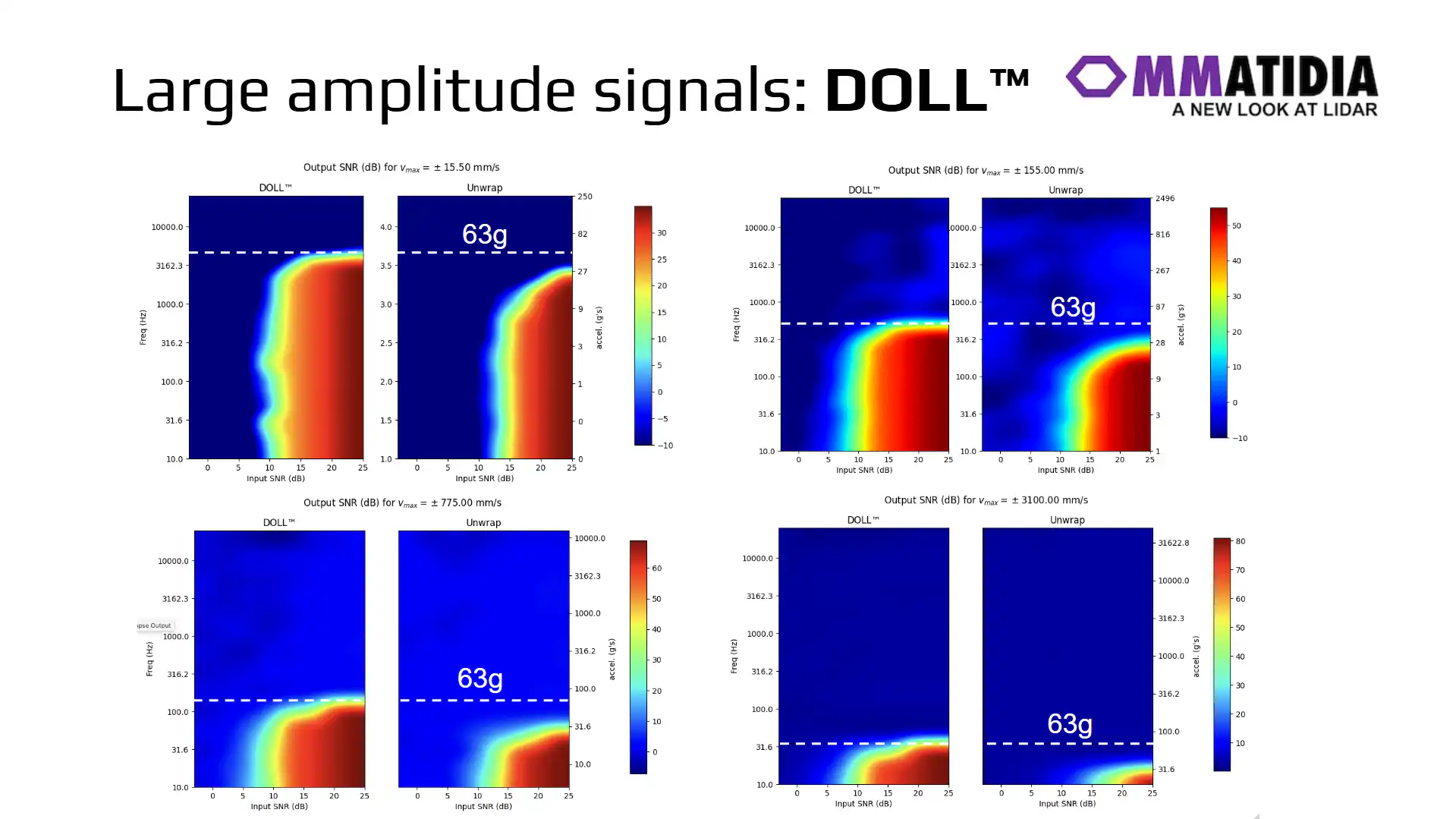
The graphs show the measurable region and the level of performance for different levels of velocity amplitude and frequency using the DOLL™ algorithms. The current limit in practice is not so much the maximum velocity but rather the maximum acceleration, which is found to be 63g. This level of acceleration is extreme, comparable to an F1 car crashing against a concrete wall. When sustained it is deadly for humans and will damage most structures.
Digital Optical Locked Loop in a Massively Parallel Laser Architecture
The DOLL™ significantly extends the measurable velocity range—up to 155 mm/s—using a Digital Optical Locked Loop in a massively parallel architecture. This technological breakthrough enables Ommatidia's Q Laser RADAR systems to capture fast mechanical movements while maintaining high measurement precision, and reducing phase distortion and noise.
With DOLL™ users can now handle high-amplitude signals. Moreover, users can configure the system for high sensitivity through adjustable filtering properties.
Working in real time, DOLL™ enables Q Laser RADAR operators to receive immediate and actionable results. This allows teams to monitor and respond to dynamic systems as they continue to operate.
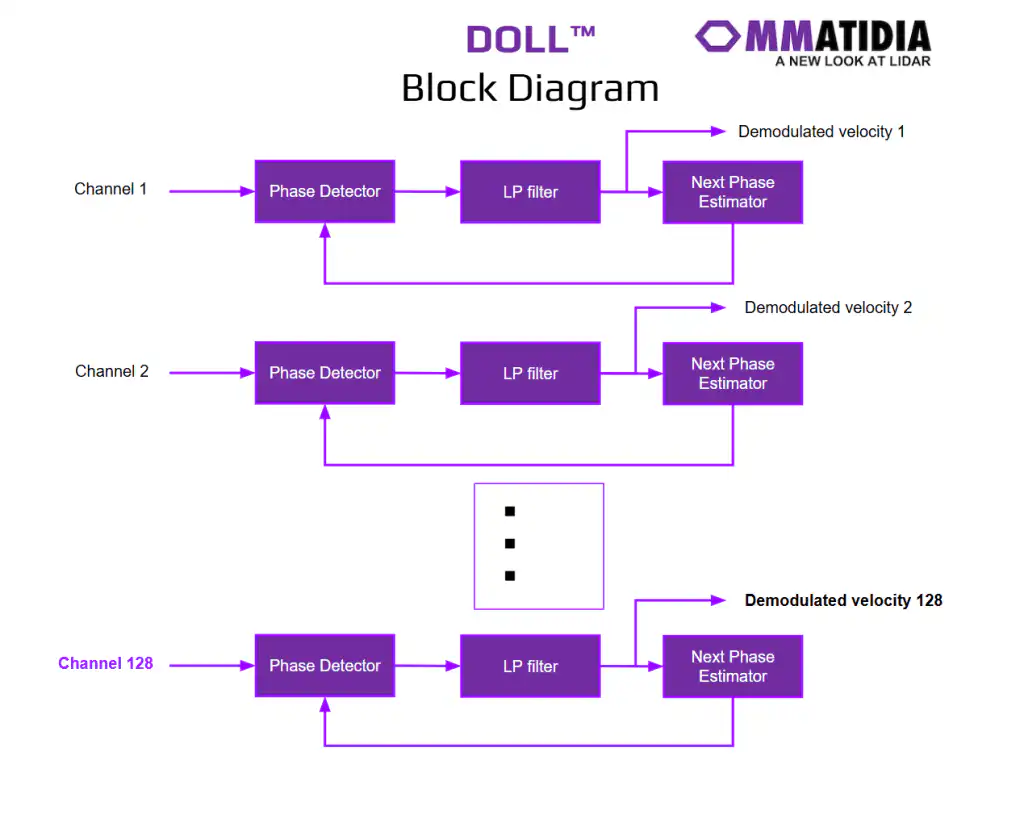
Pictured - the architecture of OMMATIDIA's unique Digital Optical Locked Loop (DOLL™) algorithm in massively parallel lasers. DOLL™ processes velocity signals across multiple channels (up to 128). Each channel follows a three-stage processing flow.
DOLL™ Empowers NVH, GVT Applications
The ability to precisely track rapid movements is crucial in many industries: automotive, aerospace, heavy machinery, and many others. Transition to massively parallel lasers technology enables engineers, system integrators, and researchers to perform simultaneous high-velocity measurements over multiple parallel laser channels, while reducing the complexity and cost of traditional testing.
DOLL™ Empowers New Applications
- Advanced NVH Applications: high-speed vibrations leads to improved noise, vibration, and harshness control in vehicles and other systems.
- Reciprocating Machines: measuring fast, repetitive movements accurately is essential for machinery with high-speed reciprocating actions.
- Non-Linear Measurement Problems: Complex systems with non-linear dynamic behavior can now be analyzed more thoroughly.
- Real-Time Monitoring: applications requiring immediate, actionable insights from high-speed data streams
- High-sensitivity applications: such as transformer vibration levels.


